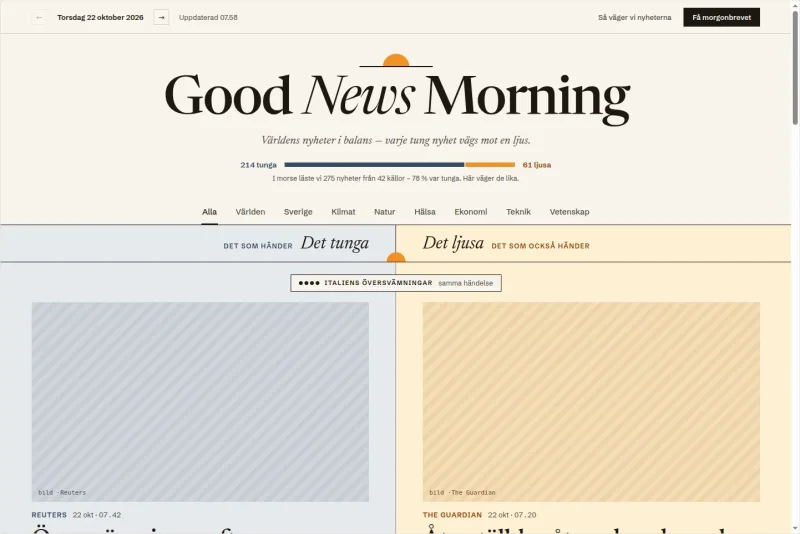
 Good News MorningA Swedish news list where every heavy story is weighed against a light one
Why a news list of my own?
The news had become too heavy. I wanted a news list that always puts a light story next to the heavy one.
Good News Morning
Good News Morning is a morning edition in Swedish with two columns: Det tunga (the heavy) and Det ljusa (the light). Headline, lead, date, link and picture come from the news sites' own RSS feeds – SVT, Sveriges Radio, DN, SvD and more, plus a few sources that only publish good news. Every item links to the original. The lead is shortened to whole sentences, and the article text is never fetched.
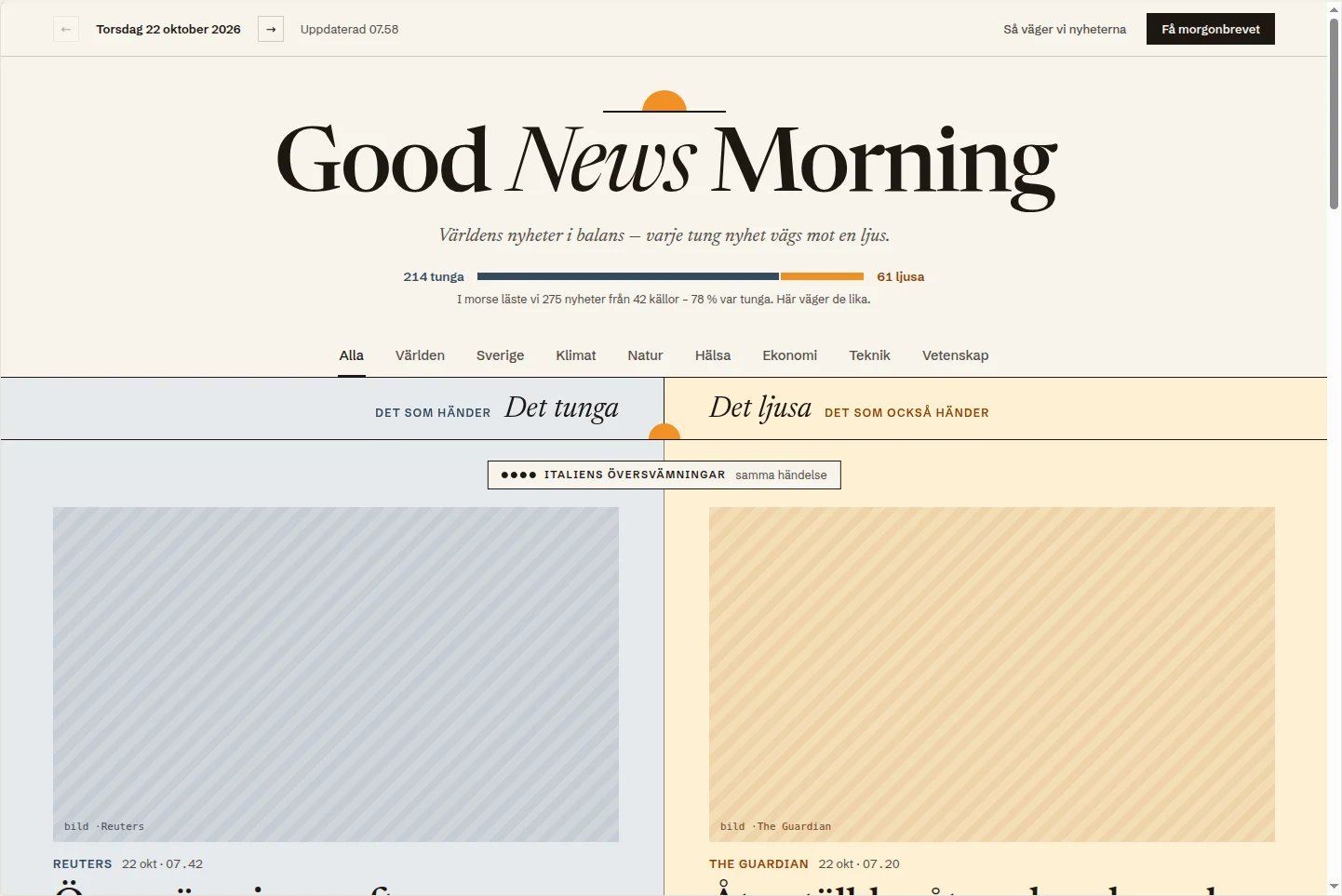
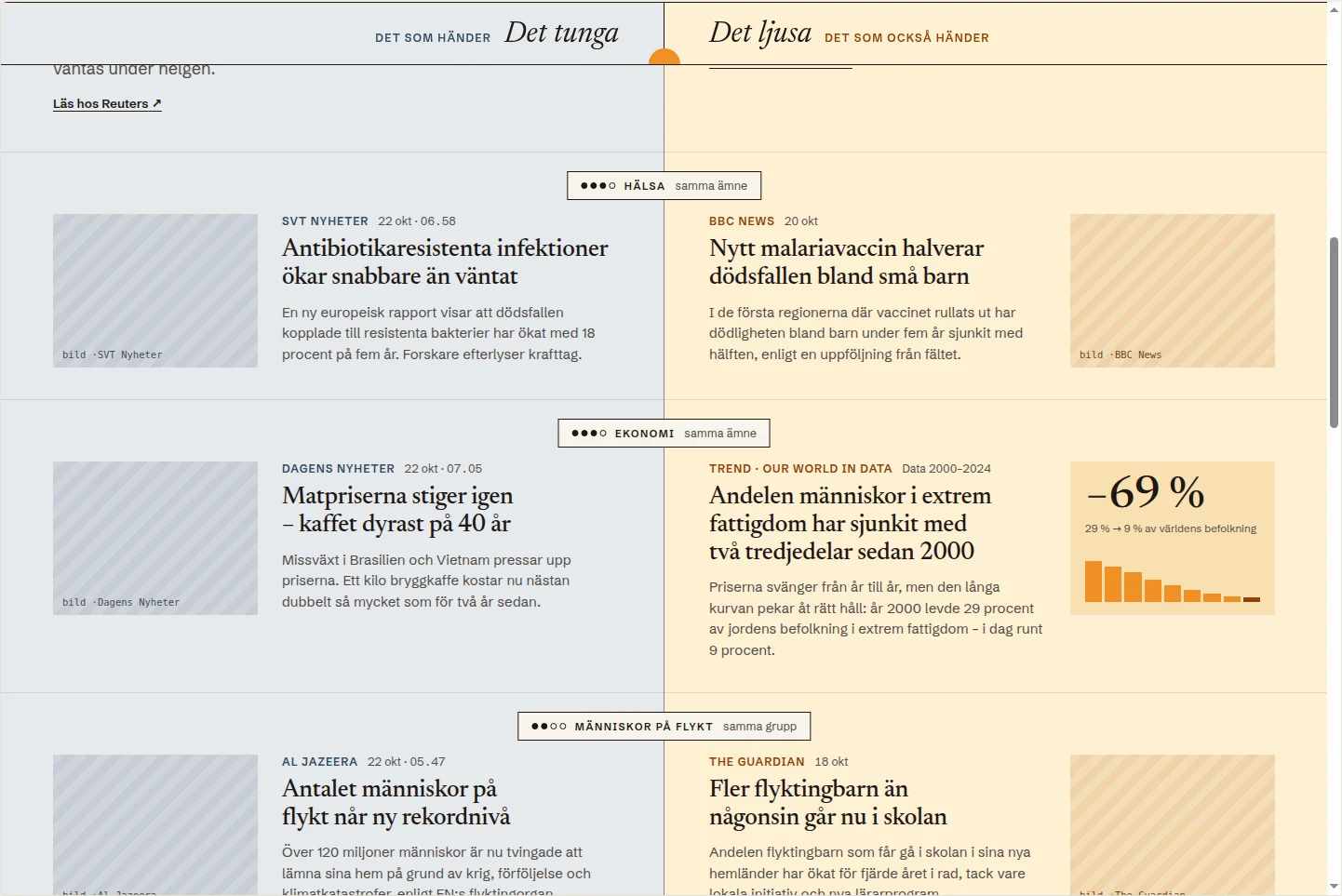
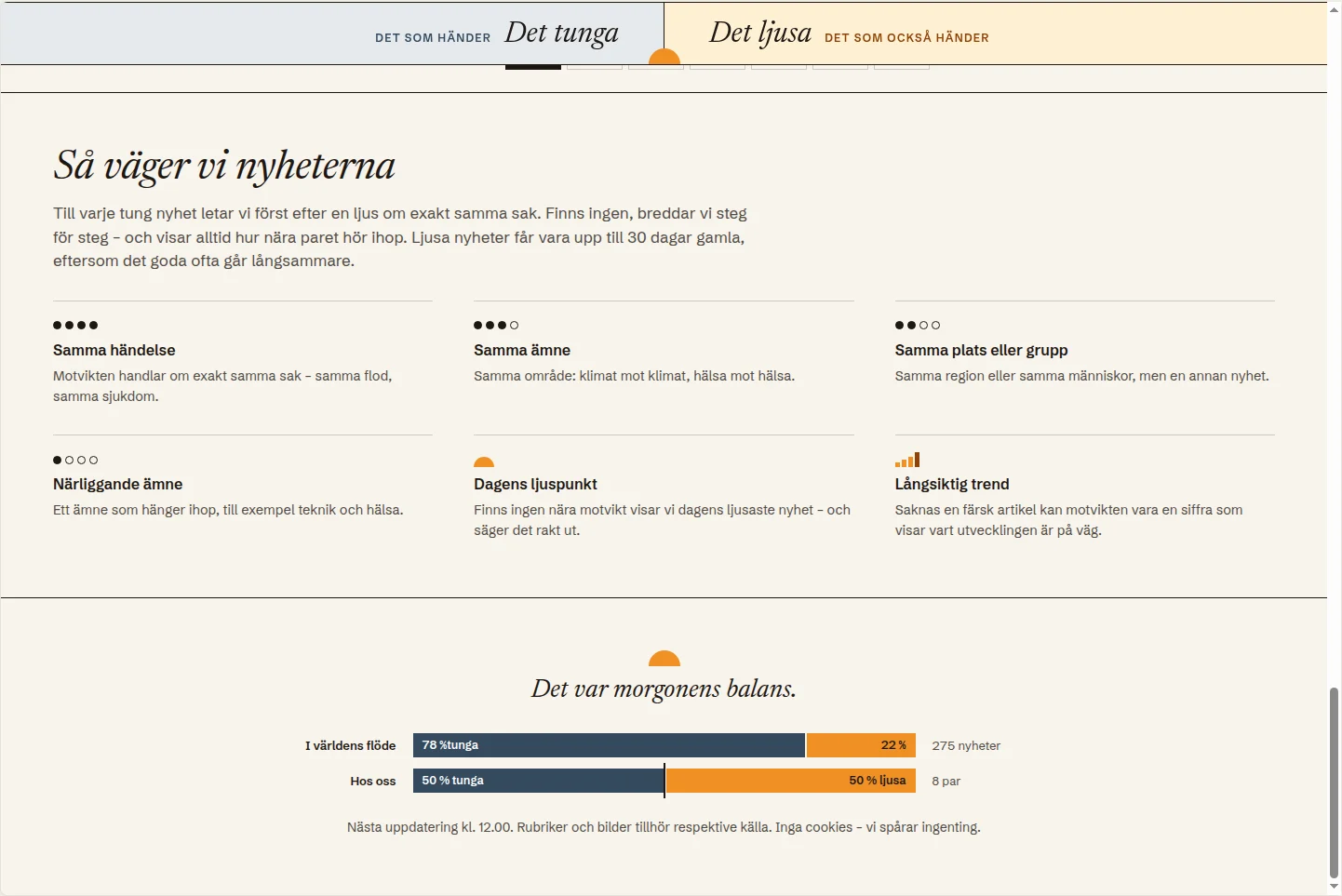
Two steps decide what ends up next to what. First, Claude reads each article once: a tone from −2 to +2, one of eight subjects, places, groups of people and a short label for the event. Then a matcher in PHP pairs them. The matcher is deterministic and testable, and it weighs the classification against how similar the texts are. The pair gets one of five levels, shown on the centre line:
- the same event – the counterweight is about exactly the same thing
- the same subject – climate against climate, health against health
- the same place or group – the same region or the same people, but a different story
- a related subject – technology and health, for example
- today's bright spot – if there's no close counterweight, one of the day's lightest stories is shown, and the page says so plainly
If there's no fresh light article in the same subject, the counterweight can be a trend card: a long-term figure with its source, such as the share of people in extreme poverty having fallen since 2000. A light story may be up to 30 days old and is used only once per morning.
Why not let a text algorithm do it all? It finds articles about the same thing, but can't tell whether a story is heavy or light: "cancer cases rise" and "cancer deaths fall" sit in almost the same place. So Claude does the classification, where a language model makes a real difference, and PHP does the pairing, which has to be explainable and testable.
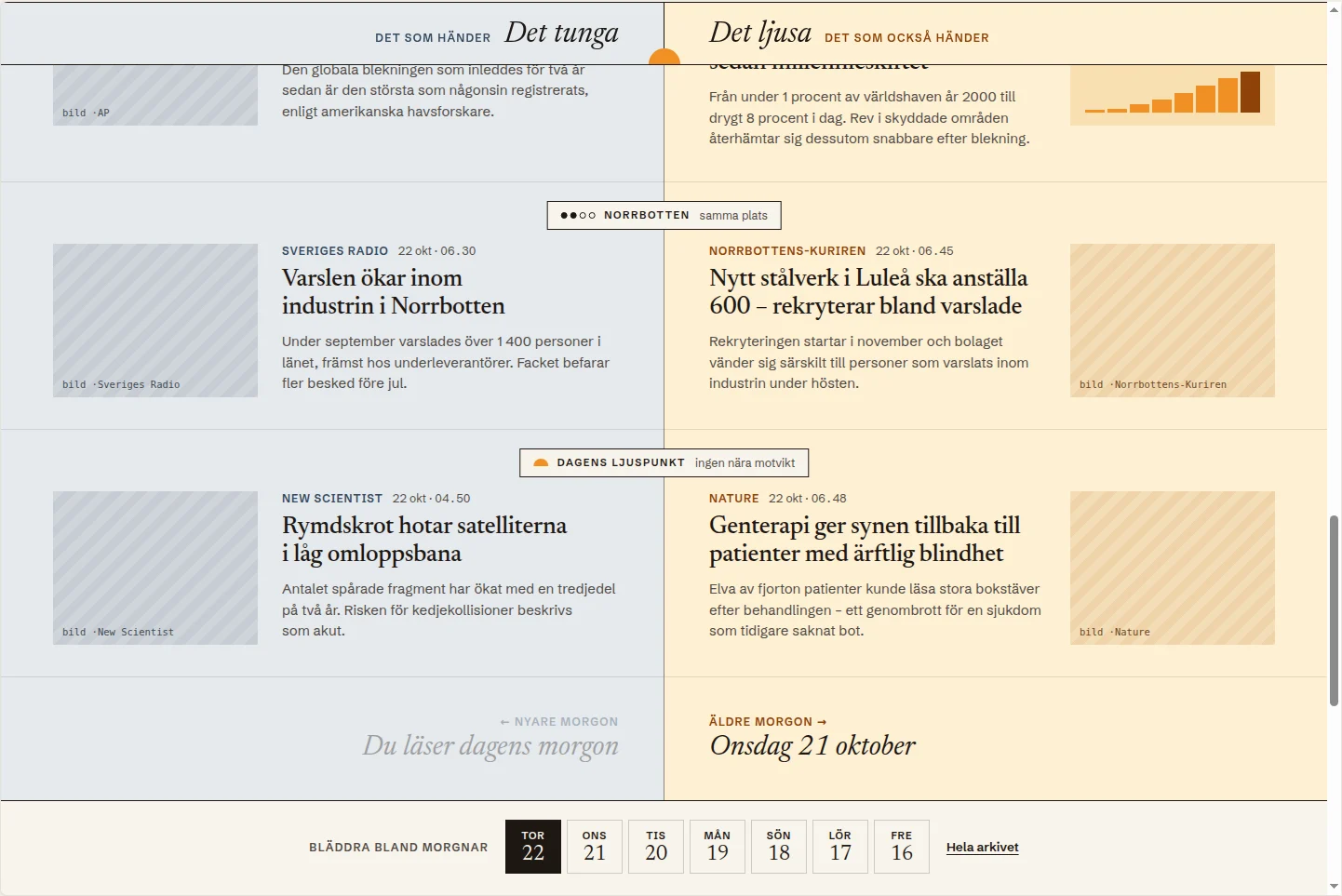
Every morning has its own address, and you can filter by subject and browse back through the archive. Below the logo and at the bottom, the morning's scale shows how many heavy and light stories came in, and what it looks like here: half of each.
The pages are built twice a day and cached whole. They need no JavaScript – the filter and the browsing are plain links – and nothing is loaded from other hosts. There's a light and a dark theme, and the site can be added to the home screen as an app of its own.
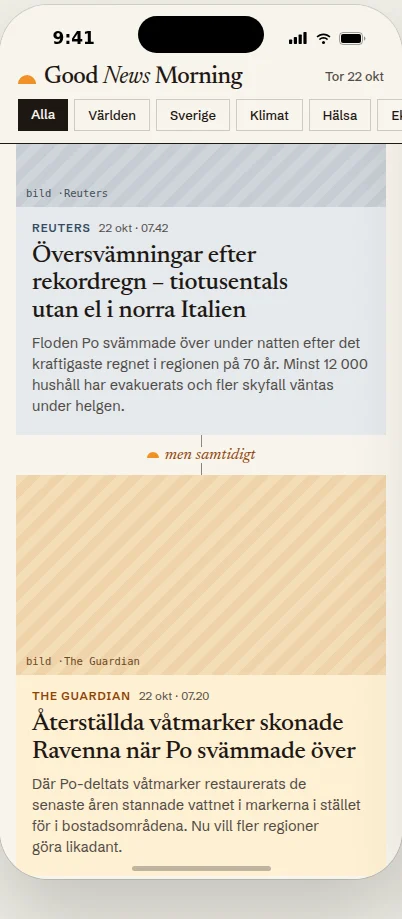
The pictures come from the sources, and photographs are protected. That's why the whole site sits behind a gate: without a key, every page answers with just the logo. The screenshots here are from the design, with made-up news.
The design was made in Claude Design and built with Claude Code, in PHP with no framework and MariaDB. Codex drew the icon in two rounds of eight proposals, and the sun over the horizon won. The work was run from an issue board, as in my other projects.
Along the way
The pairing needed a repair step. At first the matcher took the best counterweight for each heavy story in turn. "New steelworks in Luleå" then went to "Food prices rise" (the same subject), and "Layoffs in Norrbotten" was left without a counterweight. Now a heavy story that has a free trend card gives up its article to one that needs it more.
The same story shares only a name. The same story in several feeds often uses different words and shares only a proper name, such as the name of a storm. So groups are also formed on proper names in the headline, within the same subject.
Word stems hit the wrong words. A stem has to match at the start of a word and be chosen with care: "kris" (crisis) hits "Kristersson", "fred" (peace) hits "fredag" (Friday), "hot" (threat) hits "hotell" and "val" (election) hits "valet".
Science never got a pair. A pair belonged to the heavy story's subject, and science stories are almost never heavy. Now a pair belongs to the subjects of both sides, the matcher favours science as a counterweight, and the science page is filled up with light stories.
The old icon on the iPad. After switching to the new icon, the home screen still got the old one, because iOS used a saved copy from the same address. Now the icons are linked with the file's time in the address.
Try it yourself
Under Files you'll find IDEA.md: a description of the site and everything I learned during the build, written as a brief. Give it in full to Claude Code and you have the groundwork for a balanced news list of your own.