 RequesterHTTP client for APIs with collections as ordinary files
Why my own HTTP client?
To send requests to APIs and inspect the responses, I used Insomnia on macOS. But I wanted one program for both Windows and macOS, with no account required, and with all the features that are needed.
Requester
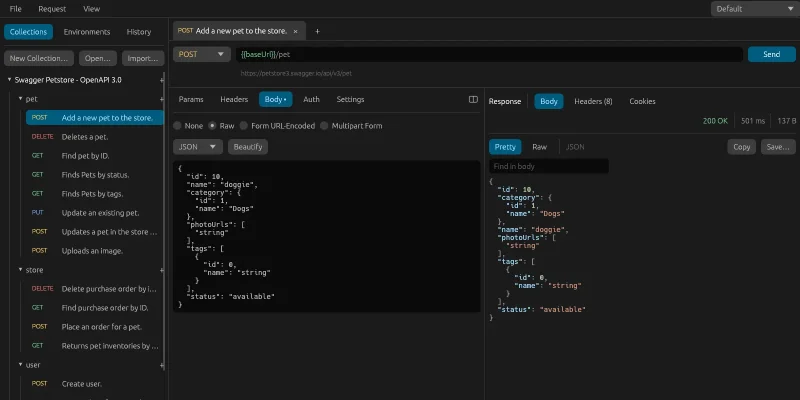
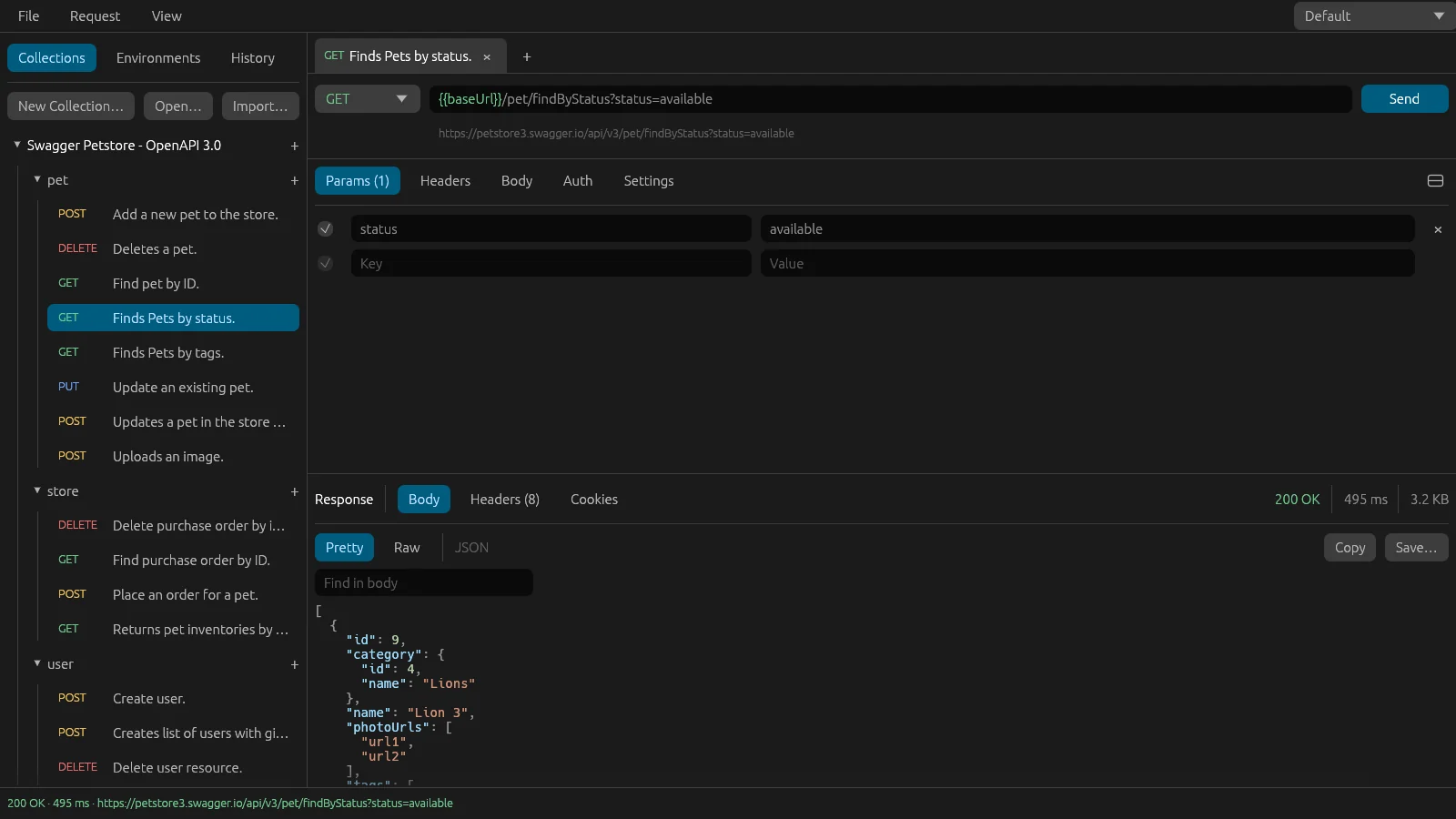
Requester is an HTTP client in the same spirit as Postman, Insomnia and Bruno. You put together a request – method, URL, params, headers, body and auth – send it and inspect the response. The response is shown with the status in colour, the time and the size, and has its own tabs for the body, headers and cookies. JSON and XML are formatted and coloured, you can search the response, copy it or save it to a file, and images are previewed.
Collections are saved as ordinary files: a collection is a directory, a folder a subdirectory and a request a JSON file. That means they can be version-controlled and compared like any code.
What the app does:
- body as raw (JSON, XML, HTML, text), a form or multipart with files
- auth: Basic, Bearer, API key and OAuth2 client credentials, which a folder or collection can share with its requests
- environments and variables:
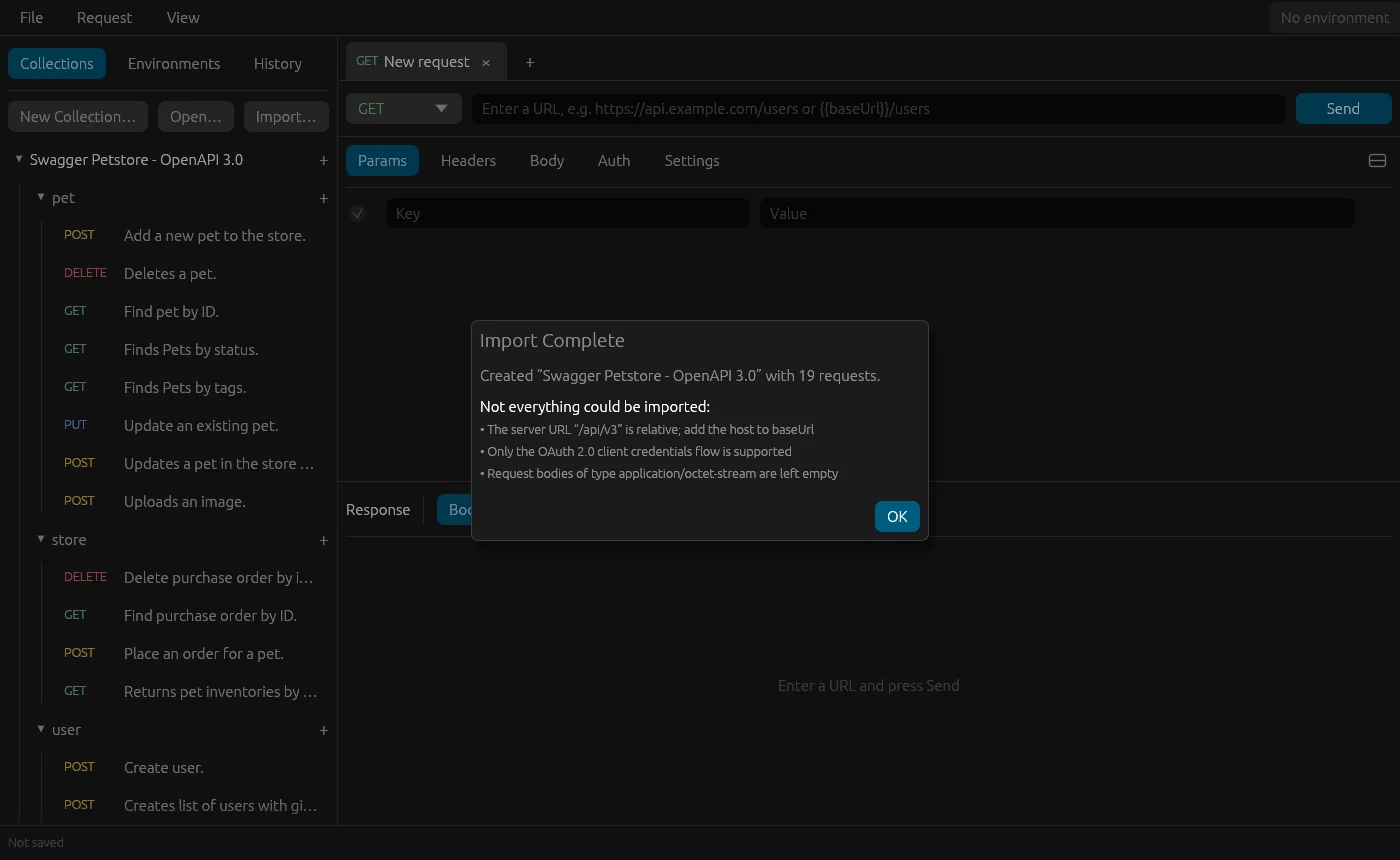
{{baseUrl}}and other variables in the URL, params, headers, body and auth. Below the URL field you can see what the URL looks like when it's sent - OpenAPI import, 3.0 and 3.1, from a file or URL, with one folder per tag and one request per operation
- cURL both ways: copy a request as cURL, or paste a cURL command into the URL field and it becomes a request
- history, settings per request (timeout, redirects, certificate checks), two layouts with the response below or to the right, and export and import of everything in one JSON file
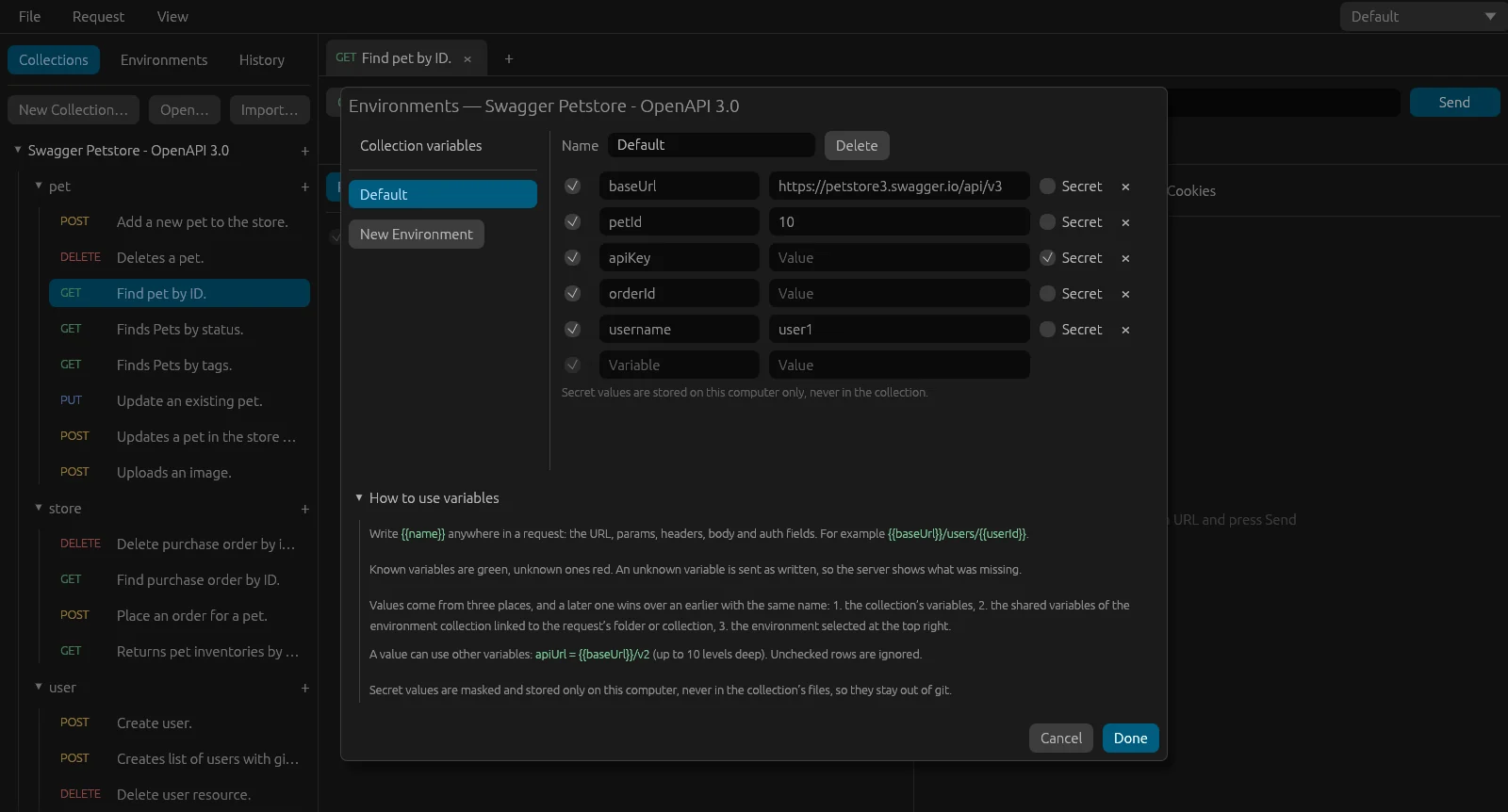
The variables live in environments, and a whole set of environments can also be saved on its own and linked to a collection or a folder. Secret values, such as API keys, are shown masked and stored only on your own computer – never in the collection's files.
Every request is sent on its own. No cookies and no tokens are kept between two requests, so an earlier request never affects how the next one is sent. The only cookie sent is the one written in the request.
The program is built with Claude Code, in Rust with egui and reqwest, for Windows and macOS, and the icon was made with Codex. Networking runs on its own thread, never in the interface. The tests send real requests to a small server of their own on the computer that answers with exactly what it received, and the interface is tried without a window with real clicks, right-clicks and key presses.
The work was run from an issue board, as in my other projects. I wrote a card with what I wanted – collections, environments, OpenAPI import and every part of a request – and asked Claude Code to research similar programs and add more. That became a dozen or so issues, and then new ones as I tried the app.
Along the way
The right-click menu never opened. The tests that click in the interface found that the menu on a request in the tree never appeared. The area for dragging requests lay on top and took the right-click. Now the row itself is draggable.
× didn't close the tab. A tab opened with + couldn't be closed. The tab registered its click after the cross, and in the interface library the one registered last wins. The cross also got bigger, and + got more room.
Changes disappeared on restart. A URL you'd typed but not saved was gone when the app was restarted. Now the open tabs with unsaved changes are saved to a file of their own, at most twice a second, and come back as unsaved.
The Cookies tab was empty the second time. The first send gave a cookie, the second gave none. The app had kept the cookie and sent it along, so the server didn't need to set it again. That was correct HTTP but looked like a bug. The tab was made to show both parts, and later I decided that every request should be sent on its own, without kept cookies or tokens.
A relative server in OpenAPI. Petstore gives its server as /api/v3, without a host. When the definition is fetched from a URL, the server is resolved against that address. If it comes from a file, you add the host to baseUrl yourself, and the import says so.
Compared with Insomnia
Insomnia is what I used on macOS. What Requester gives me:
- the same program on Windows and macOS
- no account
- collections as ordinary files that can be version-controlled
- secret values that stay on the computer
Try it yourself
Under Files you'll find IDEA.md: a complete description of the program and everything I learned during the build, written as a brief. Give it in full to Claude Code and you have the groundwork for an HTTP client of your own – the stack, the file format, the decisions that turned out to matter, the pitfalls above written as rules, and a ready-made prompt to start from.